
Don’t Hit Shuffle: Discovering the Hidden Architecture of the Psalms
Five books. One story. A journey to praise.
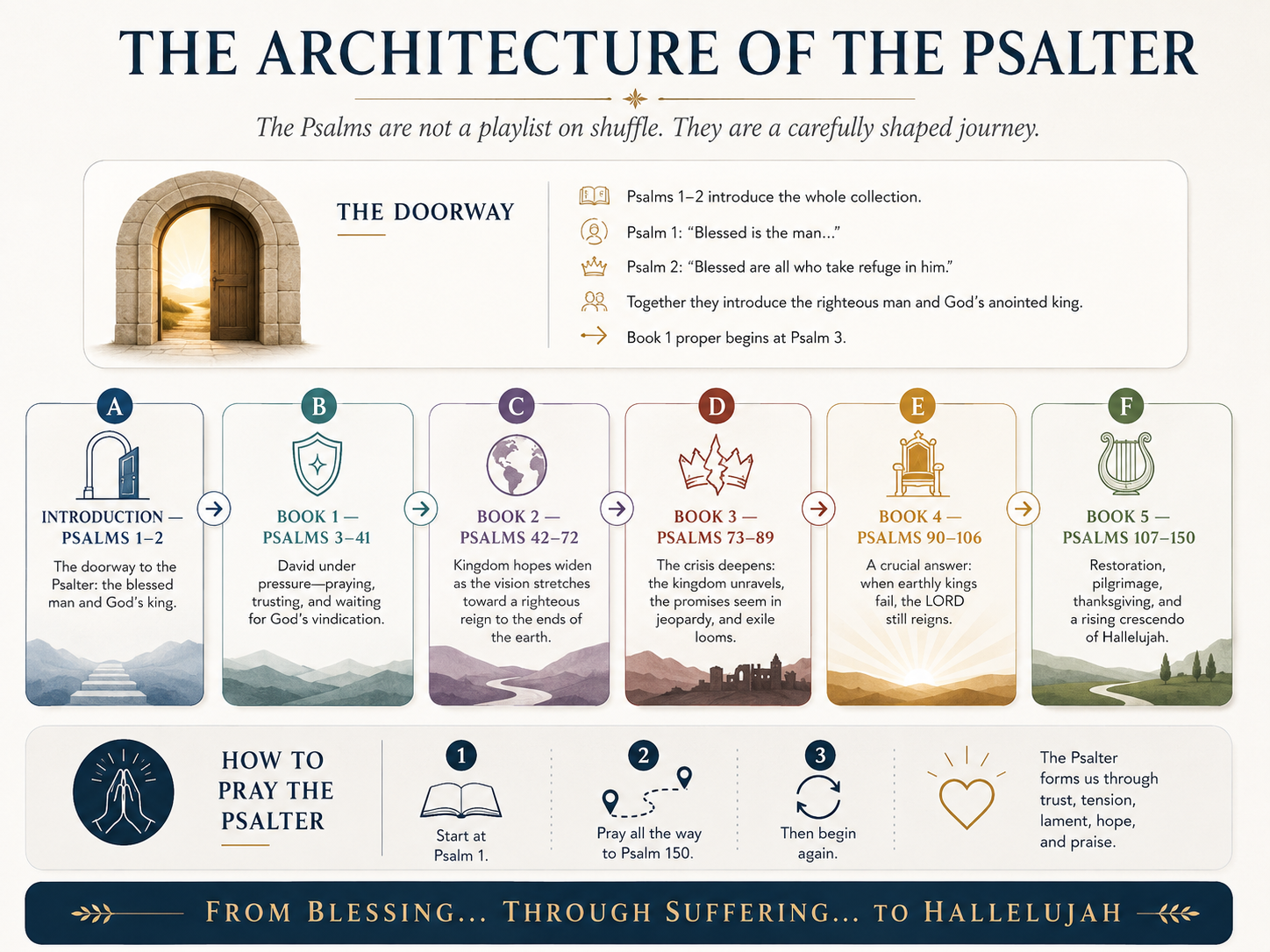
Many of us learned the “close your eyes and point” method of reading the Psalms. Pick a psalm, any psalm. There is real beauty in stumbling upon a verse that speaks directly to us, and God often meets us in those moments.
But if that’s all we ever do, it’s a little like walking into a cathedral with a flashlight. You shine the beam on a beautiful stained-glass window, then an intricate carving, then a vaulted arch. Each piece is breathtaking, but you never step back to see the cathedral itself.
The Psalms are much the same. Too often we treat them like a playlist on shuffle—moving from one favorite song to another without realizing that they were intentionally arranged in a particular order. The individual psalms are beautiful on their own, but when we begin to read them as a collection, an entirely new world opens before us.
The Psalter Is Divided into Five Books
Open your Old Testament and you’ll discover that the Psalms have been arranged into five distinct books. These divisions are not arbitrary. Each of the first four books concludes with a doxology—a brief statement of praise. Psalm 41:13, for example, closes Book 1:
Similar editorial markers occur at the close of Books 2, 3, and 4 in Psalms 72, 89, and 106. Book 5 is different. Instead of ending with a single doxology, the whole collection seems to swell into the magnificent crescendo of praise found in Psalms 146–150.
But before Book 1 begins, the Psalter gives us an introduction.
Psalms 1 and 2: The Doorway
Psalms 1 and 2 stand together as a doorway into everything that follows. Unlike the Davidic psalms that begin in Psalm 3, neither Psalm 1 nor Psalm 2 has a superscription. More importantly, the two psalms are bound together by a striking pair of blessings.
Psalm 1 opens:
Psalm 2 closes:
Read together, these two psalms seem to introduce us to a man. Psalm 1 gives us his character. He refuses the way of the wicked, delights in the Law of the Lord, and becomes like a tree planted beside streams of water. He is righteous, fruitful, and blessed.
Then Psalm 2 fills out the picture. Now we meet God’s Anointed King—the Son installed by God upon Zion, before whom the nations themselves must ultimately bow. The opening of the Psalter therefore invites us to watch for this man as we continue reading: the righteous man, the anointed king, the one in whom refuge and blessing are ultimately found.
Psalms 1 and 2 are the doorway. Psalm 3 begins the journey.
Why Five Books?
Why would the editors organize Israel’s hymnbook into five books? One compelling explanation is that they intentionally patterned the Psalter after the five books of Moses. Just as the Torah became Israel’s guide for faithful living, the Psalter became Israel’s guide for faithful praying.
The ancient rabbis themselves noticed this connection. One famous saying declares:
Moses gave Israel the five books of the Torah, and David gave Israel the five books of the Psalms.
Whether or not that was the original intention, the literary parallels are difficult to ignore. Psalm 1 opens by celebrating delight in God’s Law, and the Psalter itself seems to have been shaped as a companion to that Law—a book teaching God’s people how to respond to Him in worship, repentance, lament, thanksgiving, and praise.
The Five Books Tell a Story
After the introduction of Psalms 1–2, Book 1 begins with Psalm 3 and continues through Psalm 41. David steps onto the stage almost immediately:
That is an extraordinary way to begin. The king introduced in Psalm 2 is followed immediately by a Davidic king surrounded by enemies, suffering, praying, trusting, and waiting for God to vindicate him. Book 1 is overwhelmingly Davidic, and again and again we hear the voice of God’s anointed king crying out under pressure while continuing to trust the Lord.
Book 2 (Psalms 42–72) broadens the horizon. The collection includes psalms of the sons of Korah, Asaph, and David and moves toward an expansive vision of the kingdom. It concludes with Psalm 72 and its extraordinary prayer for the king whose righteous reign will extend to the ends of the earth.
Then everything changes. Book 3 (Psalms 73–89) is the darkest section of the Psalter. The kingdom begins to unravel, the sanctuary is threatened, Israel’s enemies triumph, and the promises made to David seem to have collapsed. Psalm 89 brings the crisis to a head. God had promised David an enduring dynasty, yet now the crown lies in the dust. The question hanging over the end of the book is unavoidable: What happened to the promises?
Then comes Book 4, and rather than immediately giving Israel another Davidic king, the Psalter lifts our eyes higher. Again and again comes the announcement: “The LORD reigns.” Before Israel ever had David, God was King. After David’s kingdom collapsed, God was still King. Human thrones may fall, Jerusalem may burn, and Israel may go into exile, but the throne of God remains untouched. This does not erase the promise to David. It places that promise inside an even greater reality: the Lord Himself reigns forever.
Finally, Book 5 (Psalms 107–150) moves toward restoration. Pilgrims journey toward Jerusalem in the Songs of Ascents. David’s voice is heard again. Thanksgiving returns. Hope blossoms. And as we approach the end, the entire Psalter begins climbing toward praise.
Psalm 146 begins with “Hallelujah.” So do Psalms 147, 148, 149, and 150. The collection that has passed through rebellion, suffering, apparent defeat, exile, and unanswered questions ends with everything that has breath praising the Lord.
The Psalter is not a playlist on shuffle. It is a carefully composed journey.
Why This Matters
Understanding the architecture of the Psalter changes the way we read—and pray—the Psalms. There is nothing wrong with turning to Psalm 23 when we need comfort, Psalm 51 when we need words of repentance, or Psalm 103 when our hearts are overflowing with gratitude. Individual psalms really do speak powerfully into particular moments of our lives. But that is not the only way they were meant to be read.
If the Psalter has been intentionally arranged as a journey, then perhaps we should allow ourselves to take that journey. Begin with Psalm 1, then Psalm 2, then Psalm 3, and keep going. Don’t stop at Psalm 50. Keep praying until you reach Psalm 150. Then begin again.
Over time, something begins to happen. We stop selecting only the psalms that match the mood we already have, and we allow the Psalter itself to shape our hearts. It teaches us to trust when enemies surround us, to lament when God’s promises seem impossibly far away, to wait when there is no immediate resolution, and to remember that the Lord reigns when everything visible seems to say otherwise. And eventually, it teaches us to praise.
That may be one of the great pastoral gifts hidden in the structure of the Psalms. The Psalter does not pretend that the life of faith moves in a straight line from blessing to blessing. It leads us through hope, tension, suffering, bewilderment, waiting, restoration, and praise. In other words, it leads us through something remarkably like the actual life of faith.
Perhaps this is where the cathedral image is helpful again. There is nothing wrong with stopping to admire a stained-glass window. But there is something more to see when we step back and discover how the windows, arches, pillars, and carvings belong together. In the same way, reading the Psalms in their intended order allows us to experience something of the breathtaking architecture of the whole.
So don’t just hit shuffle. Start at the beginning and pray all the way to Psalm 150. Then, when you finally arrive at that last great Hallelujah, turn back to Psalm 1 and begin the journey again.
A Practice for This Week
Begin with Psalm 1 and read one psalm each day without skipping ahead. Pay attention not only to each individual psalm but also to where it falls in the larger story of the Psalter. Notice what came before it and what comes after it.
Over time, you may discover that the Psalms are doing more than giving you words to pray. They are teaching your heart how to make the journey from trust, through suffering, to praise.
“The Psalter is not a playlist on shuffle. It is a carefully composed journey.”
Send this to someone who needs the Psalms this week.


Begin at Psalm 1
Read the story in order and let it shape you.