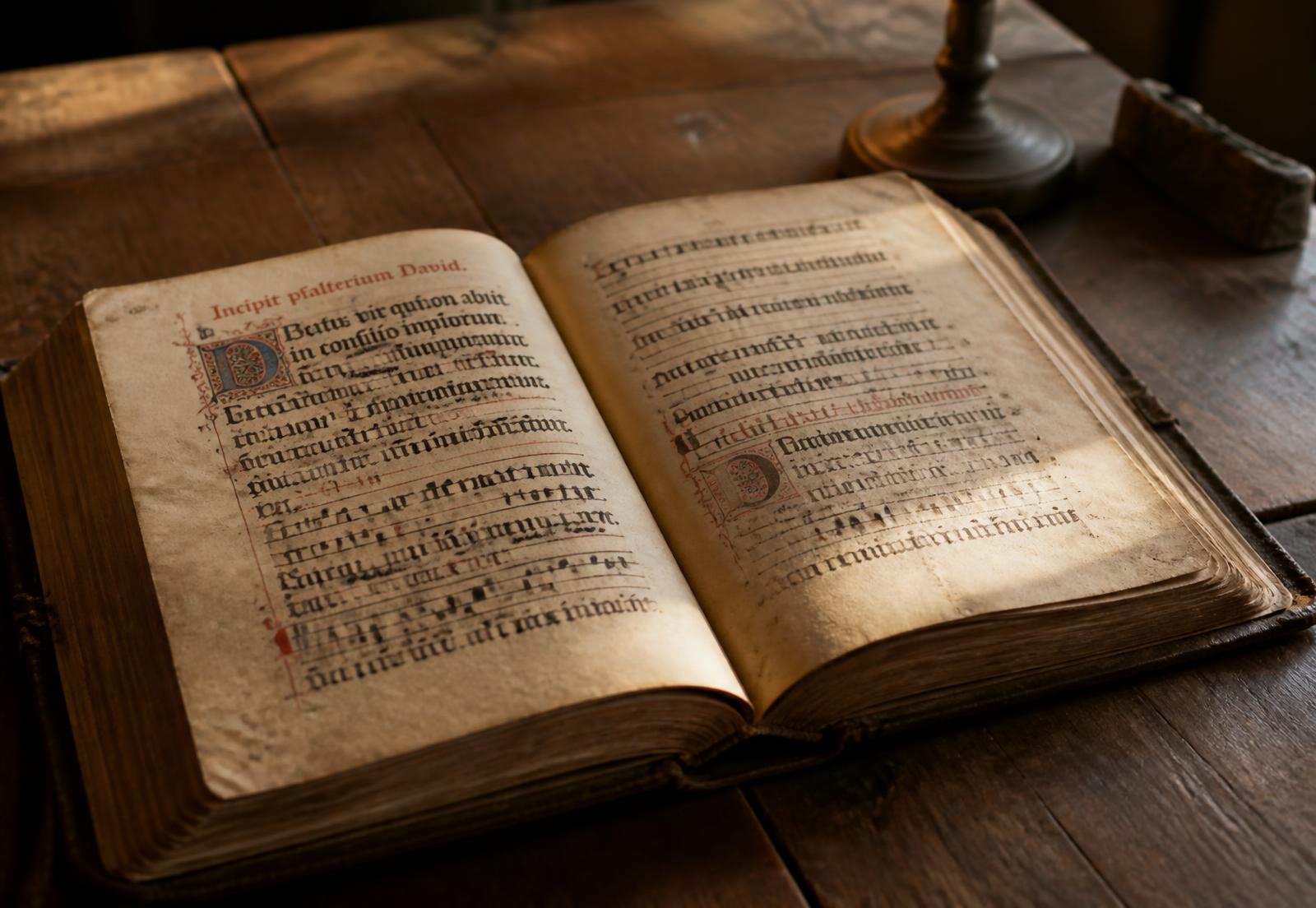
Whose Side Are You On?
Psalm 1

Psalm 1, one of the most well-known of the Psalms, demands a response from every reader to the driving question of the Book of Psalms: “Whose side are you on?”
Often, Psalm 1 is taught as a challenge for us to commit ourselves to the law of God, to delight in the Word of God, and to meditate on it so that God might “prosper” us. All of that is well and good, but that sort of teaching misses what the writer intends.
Part of the problem is that many English translations begin Psalm 1 with either “Happy are those…” or “Blessed are those…,” which can lead to the misconception that the Psalm is primarily about us. The Hebrew text begins, “Highly esteemed is the man….” In Psalm 1, the author fixes his attention on one person: “the man.” The essential question of the Psalm has to do with Him.
Who Is “the Man”?
If the critical question in Psalm 1 concerns “the man,” our initial task is to determine who this man is. The writer does not provide his name, but that does not mean we cannot learn quite a bit about Him.
The first thing we find out is that “the man” was “highly esteemed” by God. These words are similar to what Gabriel said to Mary when he announced that she would give birth to the Son of God. Gabriel called Mary “highly favored” and explained this favor with the words, “the Lord is with you.” God Himself would extend His special care to her. In a similar fashion, Psalm 1 describes “the man” as one who experiences God’s special care.
Verse 2 provides a second description: “His delight is the law of the Lord and on his law he meditates day and night.” The man is committed completely to the law of God and thus to God Himself.
Verse 1 helps us see what this commitment looks like. Three verbs—“he does not walk,” “he does not stand,” and “he does not sit”—are matched with three objects—“the advice of the wicked,” “the path of sinners,” and “the residence of mockers.” Rather than aligning Himself with the wicked, sinners, and mockers, “the man” has steadied His gaze on God and His law.
Notice the emphasis. The concern is not primarily to state what “the man” should do. The focus is on what “the man” has already done. He has shown Himself to be faithful to God through His commitment to God’s law.
Verse 3 provides another description through a vivid picture from nature. The man is “like a tree planted alongside a water channel that bears fruit in season and that has leaves that never wither.” The picture is of a tree deliberately planted beside an abundant source of water. Its roots grow deep, it regularly produces fruit, and its leaves flourish. In the same way, “the man,” planted by God Himself, is firmly grounded and vibrant.
Then comes an important final statement: “Everything he does succeeds.”
“To succeed” is another, and I think better, way to understand the NIV’s “to prosper.” The point is that “the man” proves successful in accomplishing what God has given Him to do. As we will see in Psalm 2, “the man” has a particular God-given purpose. He has a mission to accomplish, and He completes it.
A New and Greater Joshua
What is the mission of “the man”? To understand it, we should notice the close relationship between Psalm 1 and the beginning of the book of Joshua.
When Joshua was about to take over for Moses as the leader of Israel, God commanded him:
The similarities are striking. Joshua is instructed to rely completely on the law of God, meditating on it “day and night.” If he remains faithful to God’s law, God promises that he will be “prosperous and successful.” Psalm 1 uses the same ideas to describe “the man.”
The comparison with Joshua helps us understand the mission of “the man.” As Joshua took leadership over Israel, so “the man” takes the mantle of leadership over the people of God. As Joshua led according to the law of God, so “the man” leads God’s people through His complete faithfulness to that same law. As Joshua was used by God to take possession of the Promised Land, so “the man” takes possession of another “land.” And as Joshua ushered in a time of rest, so “the man” brings about a time of rest.
Yet “the man” is not merely another Joshua. He is a better and greater Joshua. His leadership surpasses Joshua’s. His faithfulness to God’s law outshines Joshua’s. The “land” He possesses dwarfs the territory Joshua conquered, and the rest He offers is deeper, fuller, and longer lasting than anything Joshua could provide.
The Wicked
Psalm 1 also introduces another group: “the wicked.” Verse 4 begins simply, “This is not the case for the wicked.” The wicked can only be understood in comparison with “the man” described in the opening three verses.
As “the man” experiences God’s guiding care and protection, the wicked do not. As “the man” clings to God and His law, the wicked reject it. As “the man” is compared to a fruitful tree, the wicked are like “chaff that the wind blows away,” the outer husk of grain that breaks apart and is scattered by the breeze.
Verse 5 adds another contrast: “Therefore, the wicked will not stand up for justice, sinners in the assembly of the righteous.” “The man” proves successful in His mission because He faithfully follows the law of God. Included in that faithfulness is His concern for justice. The wicked, having rejected God’s law, do not stand for what is right. “The man” seeks justice; they do not. The wicked cannot even take their place among “the company of the righteous.”
Whose Side Are You On?
Who, then, are “the righteous”?
In verse 6, the writer shifts our attention from “the man” and “the wicked” to the readers themselves. Every person who reads Psalm 1 faces a decision: Will we align ourselves with “the man” and His mission, or will we join the wicked? “The righteous” are those who walk in unison with “the man.” “The wicked” are those who do not.
The Psalm ends with both a promise and a warning: “For God intimately knows the path of the righteous, but the path of the wicked leads to destruction.” The righteous live under the intimate care of God. He knows their path, guides them on their way, and walks with them. The path of the wicked leads somewhere altogether different—to destruction.
Jesus Is “the Man”
We do not know who wrote Psalm 1. The Psalm presents Israel with the hope of a leader who would faithfully follow God’s law, accomplish God’s mission, overcome opposition, lead God’s people, and bring them into rest. What Israel needed was another Joshua, but an even greater one.
Who could this leader be?
Jesus is “the man” introduced in Psalm 1. Jesus is the leader Israel needed and the one the writer envisioned.
The New Testament describes Jesus in ways that echo the portrait of “the man.” At Jesus’ baptism, the Father declares, “This is my Son, whom I love; with him I am well pleased” (Matthew 3:17). Paul declares that Jesus was fully obedient (Romans 5:19), while Matthew tells us that Jesus came not to abolish the Law but to fulfill it (Matthew 5:17).
Jesus also succeeds completely in the mission given to Him. Commissioned by God to give His life for the sins of humanity, Jesus declares from the cross, “It is finished” (John 19:30). Through His death and resurrection, He defeats every power that opposes Him. He establishes His kingdom and brings His people into an eternal peace and rest.
Jesus is the greater Joshua. He is “the man” of Psalm 1, a ruler not merely for Israel but for the entire world.
Choosing Sides
All of this brings us back to the question with which we began: “Whose side are you on?”
We can commit ourselves to “the man,” Jesus, and join the company of the righteous, or we can choose the path of the wicked. One path leads us into the intimate care of God; the other leads to destruction.
Having considered the portrait of “the man” in Psalm 1, however, is there really any choice?
How can we not choose to follow Jesus?
Jesus is the greater Joshua. He is “the man” of Psalm 1, a ruler not merely for Israel but for the entire world.
“Psalm 1 may be less about becoming the man than recognizing who the man is.”
Send this to someone who needs the Psalms this week.

Experience this Psalm
Begin with any Psalm. Stay for a lifetime.