Music Is the Native Habitat of Prayer
Why God Gave Us a Book of Songs
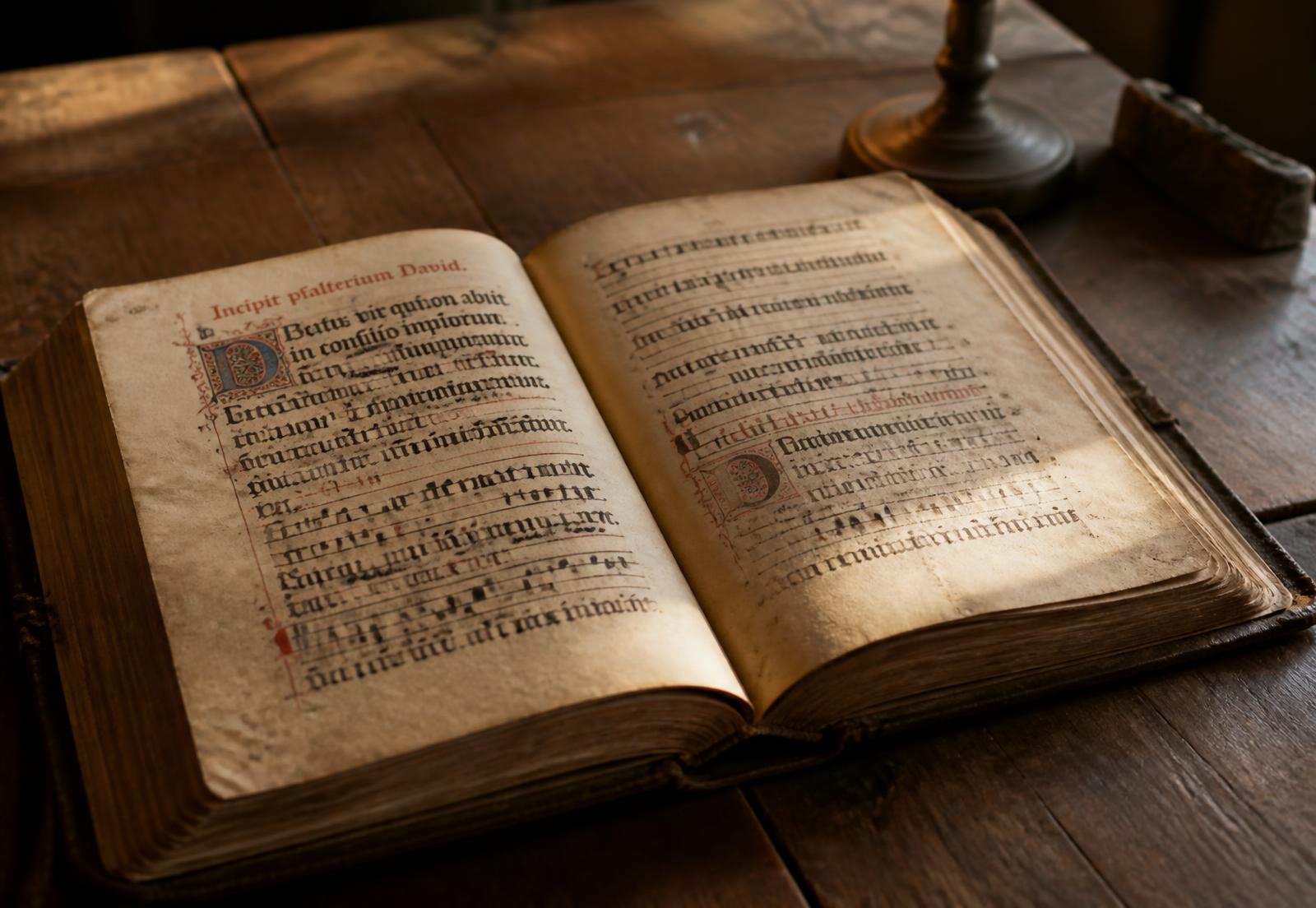
At the center of the Bible, God has given us a book of prayers. The Psalms give us words with which to address God, teaching us how to lament, praise, confess, remember, hope, rejoice, and wait. Yet there is something else about this prayer book that is easy to overlook. The Psalms are not simply prayers. They are poems, and more importantly, they are songs.
God could have given us 150 essays about prayer. He could have given us a collection of theological statements to memorize or instructions about what we should say to Him. Instead, He gave us a book of songs. Why?
The answer has something to do with the way God intends these prayers to live inside us. Music is not simply decoration added to the Psalms. Music is their native habitat.
These Were Always Songs
We do not have to guess whether the Psalms were intended to be sung. The Psalter itself continually reminds us. More than fifty Psalms are addressed in their superscriptions “For the director of music.” Some name instruments, while others identify particular tunes, such as “The Doe of the Morning,” “Lilies,” or “Do Not Destroy.” Psalm 4 includes the wonderfully practical instruction, “With stringed instruments.”
Throughout the Psalter we also repeatedly encounter the mysterious word Selah. We do not know precisely what it means, but it appears to have had some function in the musical or liturgical performance of the Psalms. Whatever its exact meaning, it is another reminder that we are reading texts that once lived in a world of singers, musicians, instruments, and gathered worship.
We no longer know the ancient tunes. We cannot reproduce exactly what these Psalms sounded like when Israel first sang them. Yet the Psalter itself leaves little doubt that these words were intended to leave the page and enter the mouths of God’s people.
Words That Make Us Slow Down
Even before the Psalms are songs, they are poetry. That matters because poetry does something different with language than ordinary prose.
Much of the language we encounter every day is designed to communicate information as efficiently as possible. We read a sentence, understand what it means, and move on. Poetry slows us down. It uses imagery, repetition, metaphor, rhythm, and carefully shaped language to make us linger over words.
Hebrew poetry frequently does this through parallelism. One line makes a statement and the next line echoes it, develops it, contrasts with it, or turns it slightly. We have to consider how the two lines relate. We hear the thought once and then hear it again from another angle. The form itself encourages meditation.
Consider the opening of Psalm 19:
We could summarize the idea very quickly: creation reveals God’s glory. That would be true, but the summary is not the Psalm. The poetry makes us look up at the heavens. It asks us to imagine the days and nights continually pouring forth speech. Instead of merely giving us a proposition to understand, it gives us an idea to inhabit.
This is one of the gifts of poetry. The Psalms are meant to be understood, but they are also meant to be inhabited. Their language invites us to stay for a while, to turn the words over in our minds, and to see the world through them.
Words That Stay With Us
Then God gives this poetry another gift: music.
Anyone who has suddenly remembered the lyrics of a song from childhood knows the remarkable relationship between music and memory. We may struggle to remember a paragraph we read yesterday and then discover that we can sing nearly every word of a song we have not heard in twenty years. Melody, rhythm, and repetition give words somewhere to live.
The Psalms give us a vocabulary for prayer. They teach us how to lament, praise, confess, remember, hope, rejoice, and wait. Yet these words become especially powerful when they are deeply familiar to us, ready to be recalled when we need them.
Imagine singing a Psalm of lament often enough that its words come to mind when suffering arrives. Imagine having words of praise already available when God gives you something wonderful. Imagine approaching death with a Psalm so deeply planted in your memory that you do not have to search for words to pray. Music can carry the words of Scripture into places in our memory that ordinary speech often does not reach.
This is one reason singing is not merely an attractive addition to prayer. Music helps the words become part of us.
Come, Let Us Sing
The relationship between prayer and music is everywhere in the Psalms, but it becomes especially difficult to miss in Psalms 95–100.
Psalm 95 begins, “Come, let us sing for joy to the LORD; let us shout aloud to the Rock of our salvation.” The worshipers come before God with thanksgiving, music, and joyful shouting. They are not simply thinking about God or even speaking to Him privately. They gather together, lift their voices, and sing. Prayer has become the song of the people of God.
Psalm 96 begins again: “Sing to the LORD a new song; sing to the LORD, all the earth.” The song immediately moves outward. God’s people are to “declare his glory among the nations, his marvelous deeds among all peoples.” The worship of God cannot remain contained within Israel. The nations are invited into the song.
By Psalm 98, even the nations are not enough. The harp, trumpets, and ram’s horn join the singing. Then the sea resounds, the rivers clap their hands, and the mountains sing together for joy. The whole creation becomes a choir celebrating the coming of the Lord. These Psalms are difficult to imagine as quiet words on a page. They want to make noise.
Enter His Gates
There is another important feature of these Psalms. The singing takes place in the presence of God.
Psalm 99 describes the LORD as the one who “sits enthroned between the cherubim.” This takes us directly into the world of the tabernacle and temple, where God dwells among His people. Then Psalm 100 invites us to enter: “Enter his gates with thanksgiving and his courts with praise.”
We sometimes think about the temple primarily as a place of sacrifice, and of course it was. Yet it was also a place of music. David appointed skilled musicians and singers to lead the people in worship. Among their leaders were Asaph, Heman, and Jeduthun, names that we continue to encounter in and around the Psalms themselves. This musical ministry became an established part of Israel’s worship. The temple was filled not only with sacrifices and prayers, but with choirs, instruments, and songs of praise. God’s people gathered there to pray, praise, give thanks, listen, remember, and sing.
This becomes especially important when we remember what eventually happened to the temple. Jerusalem fell. The temple was destroyed. God’s people were scattered. Yet Israel carried its songs into exile. They could remember God’s mighty acts, lament the destruction of Jerusalem, hope for its restoration, and continue to sing the prayers of God’s people even when they were far from Zion.
In this sense, the Psalter became something like a portable temple. The stones of the temple could be torn down, but its songs could travel.
A Virtual Temple
The Psalter continues to function as a kind of portable or virtual temple. Wherever God’s people have gone, the Psalms have carried with them the worship, memory, story, and hope of Israel.
For Christians, this becomes even more significant because we pray these Psalms with Jesus. Jesus sang these songs, prayed these prayers, and understood His life and mission through them. United to Him, Christians in every nation and language enter this same world of worship. We remember God’s mighty acts, learn the same language of praise, lament, confession, thanksgiving, and hope, and address the Father with words that the Son Himself prayed. The temple in Jerusalem no longer stands, but through Jesus its songs have gone out to the ends of the earth.
This is why the idea of a virtual temple is more than a metaphor for a shared songbook. The Psalter gathers the people of God into the worship of Israel as that worship finds its fulfillment in Jesus. Christians may gather in cathedrals and storefronts, living rooms and school cafeterias, under trees and in buildings that look nothing like the temple in Jerusalem. Yet when the church takes the Psalms onto its lips, we join a worshiping community that stretches across cultures, centuries, and continents, and whose center is Christ.
This also helps us understand something important about Christian worship. Singing is not merely the entertaining part of a worship service before we get to the more serious work of teaching. Music is one of the ways the Word of God takes up residence among us. It teaches us, forms us, gathers us, and gives us words that we carry home.
A Book Meant to Be Sung
If all of this is true, then recovering the Psalms requires more than reading them. We should read them, study them, meditate on them, and pray them. Yet we should also recover something that would have been obvious to the people who first received them: we should sing them.
God has given us poetry because some truths need to be lingered over. He has given us music because some words need to be remembered. He has given these songs to His people so that we can pray them together and carry them with us wherever we go.
This is what it means to say that music is the native habitat of prayer. Prayer is not merely information transferred from our minds to God. It engages memory and imagination, sorrow and delight, body and voice. The Psalms give us words to inhabit and words to remember, and music helps those words take up residence within us.
Of course, saying that the Psalms should be sung raises another question. What music should we use? The words of the Psalms are inspired, but the melodies are not. The church has received the words, but every generation and culture must discover how to sing those ancient words faithfully in its own musical language.
That question deserves an article of its own.
“God could have given us 150 essays about prayer. Instead, He gave us songs.”
Send this to someone who needs the Psalms this week.

- Part 1 of 2Music Is the Native Habitat of Prayer You are here
- Part 2 of 2Sing to the Lord a New Song
Sing one of these Psalms
These prayers were written to be sung. Enter one and hear it.